

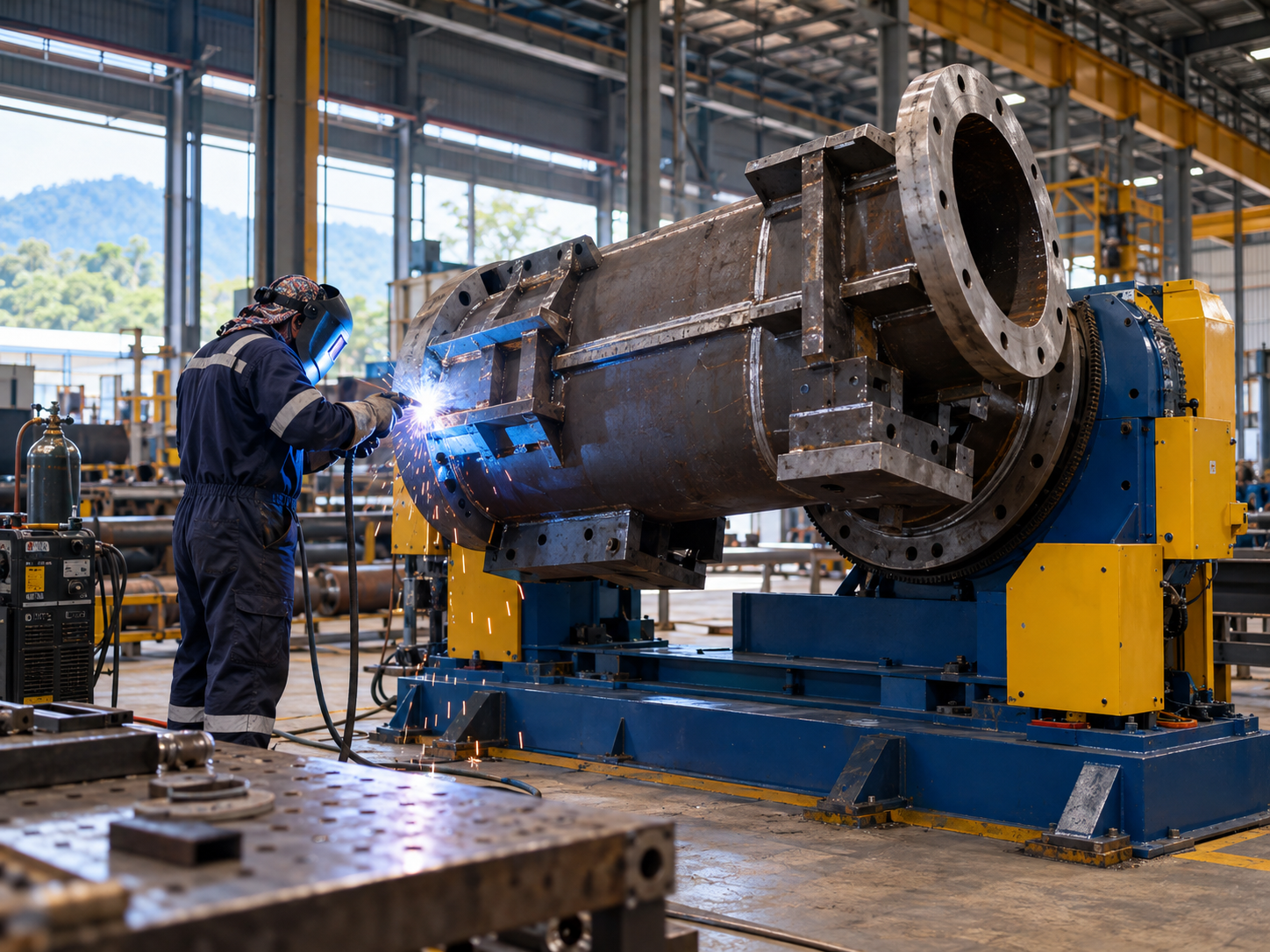
Choosing a welding positioner in Malaysia starts with the complete workpiece and fixture, not the machine’s advertised kilogram rating. Buyers need to check the combined load, centre of gravity, allowable tilt and rotation moments, required welding speed and clearance throughout the planned movement. A positioner that meets the nominal weight limit may still be unsuitable for an eccentric or awkwardly shaped assembly.
For Malaysian fabrication workshops, the right equipment can present a weld at a practical angle and support more consistent movement during circumferential welding. It cannot, however, correct an unsuitable fixture or replace an approved welding procedure. This guide explains how to compare common positioner types, develop an initial sizing brief and request technically comparable quotations.
What does a welding positioner do?
A welding positioner holds and reorients a secured workpiece so the joint can be accessed or moved at a controlled speed. Depending on its design, it may rotate a table, tilt an assembly or coordinate movement with a welding robot. Its function differs from that of the welding power source: the positioner controls workpiece movement, while the welding equipment and procedure govern the joining process.
For example, a workshop producing circular flanges may use controlled rotation to present a continuous joint to a relatively stationary torch. A long pressure-vessel shell, by contrast, may require turning rolls that support the cylindrical body along its length. The workpiece shape and weld path therefore determine the suitable movement arrangement before load capacity becomes the deciding factor.
Which welding positioner type suits the workpiece?
Match the positioning mechanism to the weld geometry, support points and access requirements. A rotary table, a tilt-and-rotate unit and a set of turning rolls may all move steel fabrications, but they distribute loads differently and cannot be selected from a single capacity figure.
| Equipment type | Typical workpiece | Selection priority |
|---|---|---|
| Rotary turntable | Flanges, rings and compact circular assemblies | Table orientation, supported load, eccentricity and stable rotation speed |
| Tilt-and-rotate positioner | Brackets, pipe spools and mixed fabrication jobs | Tilt moment, rotation loading, clamping and full swing clearance |
| Turning rolls / welding rotators | Cylindrical vessels, large tanks and long pipes | Diameter range, roller-set loading, stability and drive traction |
| Headstock-and-tailstock positioner | Long frames requiring support at both ends | Fixture span, alignment, load distribution and synchronised movement |
| Robotic or multi-axis positioner | Repeatable assemblies inside an automated welding cell | Robot compatibility, coordinated axes, repeatability and safeguarding |
ASB Welding lists the ProArc PT welding positioner series, with published nominal capacities from 100 kg to 20,000 kg. Its PT-102/202 digital positioners are listed as 100 kg and 200 kg models. These are product-family descriptions, not approval for a particular workpiece geometry, tilt angle or fixture.
How should buyers calculate load capacity and centre of gravity?
Add every component supported by the positioner, then evaluate where the combined weight acts. Include the workpiece, chuck, adaptor plate, fixture and any attached tooling. A heavy fixture can change both the total mass and the assembly’s centre of gravity (CG), even when the steel component itself remains unchanged.
Step 1: Calculate the complete supported mass
Suppose a pipe assembly weighs 180 kg and its fixture weighs 35 kg. The positioner must support at least 215 kg, excluding any additional attachments. Selecting a 200 kg model by comparing only the 180 kg workpiece would overlook a known part of the load. The supplier must also verify the permitted loading arrangement, not simply confirm that a larger model exists.
Step 2: Identify the CG relative to each relevant axis
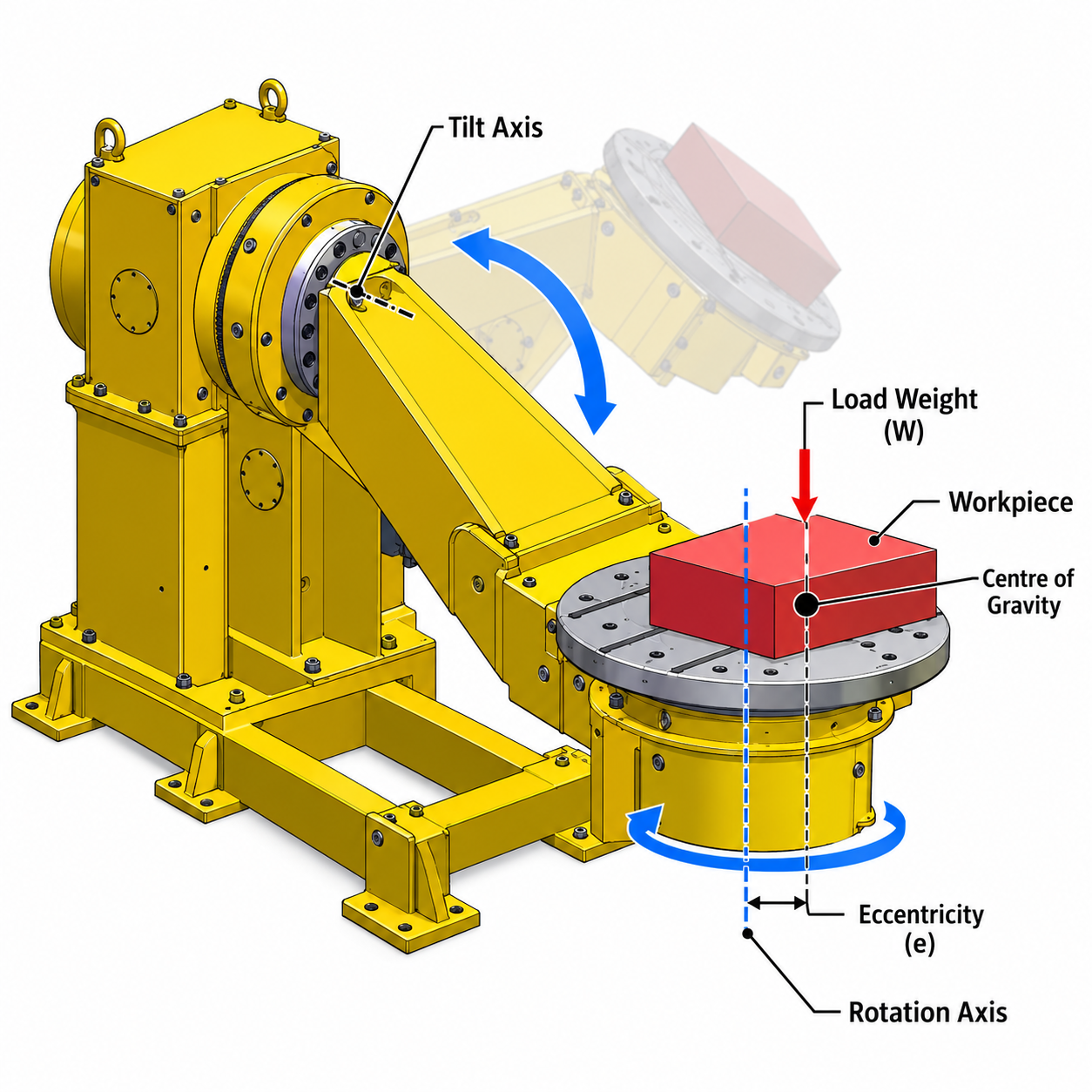
Mass alone does not establish the moment acting on a tilted assembly. For an illustrative load whose CG has a 0.12 m perpendicular lever arm from a horizontal tilt axis at its most demanding orientation, the gravitational moment is approximately:
215 kg × 9.81 m/s² × 0.12 m = 253 N·m
This calculation is a preliminary illustration, not a positioner rating or a complete drive calculation. Actual tilt loading depends on the assembly’s geometry and orientation. A vertical-table rotation axis presents different loading considerations: the same gravitational moment formula cannot simply be applied as the required rotation-drive torque. Eccentricity, bearing loads, inertia, acceleration and the manufacturer’s allowable moments still need evaluation.
Step 3: Confirm the manufacturer’s operating limits
Ask for the selected model’s allowable payload at the proposed CG height and offset, along with its separate tilt and rotation limits where applicable. The supplier should also review the mounting interface, clamping arrangement and dynamic operating conditions. A model’s headline capacity is only one element of this assessment.
How do you choose the correct welding positioner rotation speed?
Start with the required weld travel speed and the actual joint diameter. For a circular joint at a constant radius, rotating the workpiece at a steady speed can help present the seam to the torch. The correct travel speed must still follow the applicable welding procedure and process requirements; a positioner does not establish welding parameters by itself.
Positioner speed (rpm) = weld travel speed (mm/min) ÷ (π × weld diameter in mm)
For example, a 600 mm circular weld at an illustrative travel speed of 300 mm/min gives 300 ÷ (3.1416 × 600), or approximately 0.16 rpm. This is a geometry calculation, not a recommended welding setting. Confirm actual travel speed, weld position and any procedure constraints before using the result for equipment selection.
ASB’s PT-102/202 product listing includes selectable speed ranges such as 0.15-4 rpm and 0.3-8 rpm. An operating point near a range limit warrants particular attention to speed stability under the intended load. Ask the supplier to verify the exact variant, usable speed range and control performance rather than assume every listed option suits the application.
Where the weld path is non-circular or its effective radius changes, a fixed rpm may not maintain the required joint travel speed. Such work may call for different motion control, staged repositioning or coordinated robotic movement.
What dimensions and workshop conditions affect selection?
Check the full moving envelope, including fixtures and protruding parts. A positioner may carry an assembly within its rated mass yet lack sufficient clearance when the table tilts. Document the maximum outside dimensions at every intended orientation and assess the loading and unloading sequence as carefully as the welding operation.
| Requirement | Why it matters | Information to prepare |
|---|---|---|
| Maximum assembled load | Includes the fixture and attachment mass | Separate workpiece and fixture weights |
| CG and eccentricity | Influences allowable tilted and rotating loads | Estimated CG for each mounting arrangement |
| Swing envelope | Determines clearance from the floor and nearby machinery | Maximum length, width, projections and tilt angle |
| Workpiece restraint | Keeps the assembly secured through the planned motion | Chuck, faceplate, clamps and fixture drawings |
| Workshop services | Affects installation and welding integration | Power supply, lifting access, fume control and cable routing |
The welding-current return path also needs attention. Establish how the selected machine conducts the return current and whether its design is suitable for the proposed welding process. Avoid routing welding current through bearings or other unintended paths. ASB describes a dedicated grounding arrangement for its ProArc PT series; verify its capacity and installation instructions for the actual model.
When are turning rolls or robotic positioners the better choice?
Choose turning rolls when a cylindrical workpiece needs distributed support, and consider coordinated robotic positioners when the weld demands programmable movement. Neither option is automatically more productive or safer. The fabrication geometry, fixture design and entire operating cell determine the outcome.
For pipe and vessel work, ASB lists self-aligning turning rolls for defined diameter and load ranges. Its ProArc turning-roll range also covers cylindrical rotation, although the public page presents different capacity figures. Obtain the current model-specific datasheet before relying on a maximum load claim.
For automation projects, the robotic L-type positioner and robotic headstock-and-tailstock equipment provide different starting points for workpiece orientation and robot integration. Buyers should define the required axes, fixtures, robot interface, operating sequence and safeguarding before discussing a particular configuration. ASB also lists an E.Z.Arc circumferential welding system built around positioning components.
If the project centres on robot programming and complete welding-cell architecture rather than a positioner purchase, ASB’s robotic welding systems guide covers that separate topic in greater depth.
Which safety and commissioning checks belong in the purchase?
Assess the proposed machine in its actual workshop, not only against a catalogue description. Moving a heavy or eccentric fabrication introduces potential trapping, collision and load-restraint hazards. The site team should review how operators load, clamp, move, weld and unload the component, then verify appropriate protective measures before commissioning.
Malaysia’s Department of Occupational Safety and Health (DOSH) Machinery Safety Basic e-Guide addresses risk assessment, machine guarding and protective devices. The American Welding Society’s guidance on handling heavy weldments offers a complementary professional perspective on planning and moving substantial fabrications.
- Load and fixtures: Confirm the manufacturer’s permitted loading arrangement and check that clamps and supports remain effective throughout the full movement.
- Access and controls: Evaluate pinch points, exclusion zones, start/stop controls, emergency stops, isolation and prevention of unexpected movement.
- Installation: Review floor capacity where relevant, lifting methods, electrical supply, cables and welding-current return.
- Welding exposure: Assess fume extraction, arc screening and protection of nearby personnel. The UK’s Health and Safety Executive guidance explains source control and local exhaust ventilation for welding fumes.
- Handover: Request the operating instructions, maintenance requirements, operator training and a documented check of agreed functions under representative conditions.
These references provide safety context; they do not establish that a proposed positioner complies with Malaysian legislation or that a specific installation is safe. The responsible employer, supplier and suitably qualified personnel must identify and apply the requirements relevant to the workplace. UK guidance is supplementary, not Malaysian law.
What should a Malaysian buyer include in a welding positioner RFQ?
Use the same engineering brief for each supplier so that quotations cover comparable equipment and services. At a minimum, attach the workpiece drawing, supported mass, fixture details, intended welds and maximum required movement. This lets suppliers review the configuration instead of relying on the ambiguous description ‘heavy-duty welding positioner’.
| RFQ item | What to provide or request | Decision supported |
|---|---|---|
| Load and geometry | Part and fixture weights, drawings, CG estimate, maximum dimensions | Payload, moment and clearance checks |
| Welding motion | Weld diameter, process, travel speed, rotation and tilt requirements | Drive range and motion control |
| Fixture and handling | Clamps, chuck or faceplate, lifting method, installation footprint | Practical setup and restraint |
| Technical documents | Current datasheet, rated-load details, operating manual, controls and electrical requirements | Model-specific verification |
| Commercial scope | Fixtures and options, delivery, installation, training, warranty and after-sales terms | Comparable total project cost |
Ask suppliers to distinguish standard equipment from optional accessories and application-specific services. Where several product sizes are manufactured, agree on how the selected model will be demonstrated with a representative, securely mounted load. This approach makes the quotation more useful than a price comparison based solely on maximum capacity.
Conclusion: Select the positioner around the real weld
The right welding positioner is the one that supports the complete assembly, accommodates its centre of gravity and moves the weld at the required speed within a properly assessed workspace. Start with the load, geometry and weld path. Then verify the model’s actual operating limits, fixture, controls and installation requirements.
For Malaysian fabrication teams, this disciplined approach reduces the risk of buying a machine that looks capable on paper but cannot accommodate the proposed job. It also helps suppliers provide clearer, more comparable technical quotations.
Frequently Asked Questions
Can I choose a welding positioner using only its kilogram rating?
No. Include the workpiece and fixture weight, then confirm the centre-of-gravity location, allowable moments, mounting method and clearance. The selected manufacturer’s load limits apply to specific operating conditions.
How do I calculate the rpm for a circular weld?
As an initial geometry calculation, divide weld travel speed in mm/min by pi multiplied by weld diameter in mm. For example, 300 mm/min around a 600 mm diameter joint gives approximately 0.16 rpm. Use the actual welding procedure to establish travel speed and confirm machine suitability.
When should I choose turning rolls instead of a tilt-and-rotate positioner?
Turning rolls may be more appropriate for long cylindrical pipes or vessels that need support along their length. A tilt-and-rotate table may suit compact or irregular parts that can be clamped securely. Confirm the entire support arrangement and loading limits.
Does a positioner eliminate the need for welding safety assessments?
No. The employer and qualified project team still need to assess clamping, movement, access, controls, welding fumes and the installation. Follow the manufacturer’s instructions and identify the Malaysian requirements that apply to the workshop.
Discuss Welding Positioner Requirements with ASB Welding
ASB Welding lists ProArc welding positioners, turning rolls and robotic positioning equipment for fabrication applications. Send your workpiece drawing, combined weight, fixture information and intended welding sequence to ASB Welding. Ask the team to confirm available models, current specifications, suitability and any required installation or support services before requesting a final quotation.