

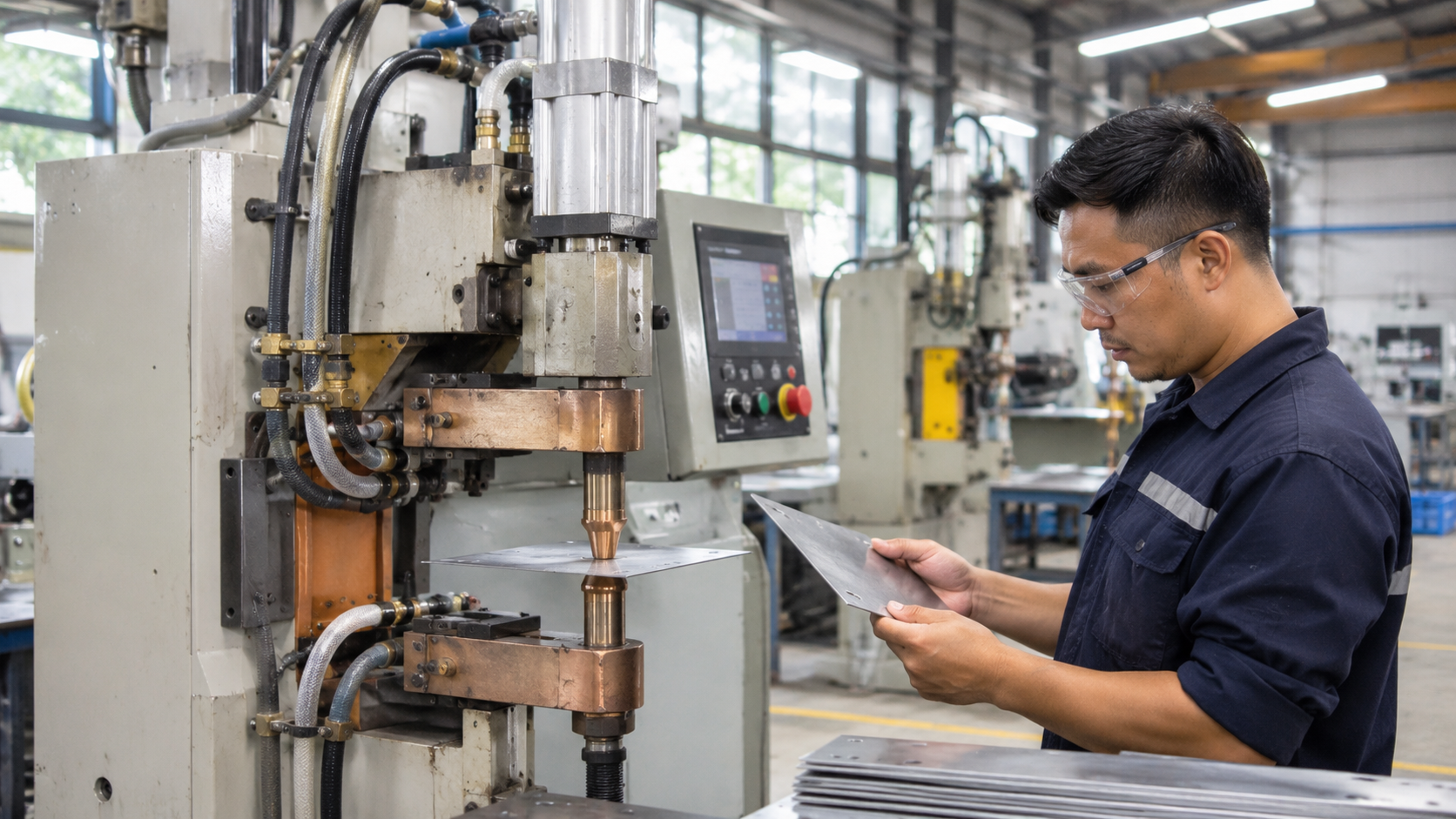
Choosing between an AC and an inverter spot welding machine starts with the sheet-metal joint, not the advertised kVA rating. Two machines may both be labelled for resistance spot welding yet differ in current control, electrode-force capability, cooling, working clearance and the records available for quality assurance. Buying the more sophisticated controller will not solve poor sheet fit-up or worn electrode tips.
This guide compares AC vs inverter spot welding machines for Malaysian fabrication and manufacturing teams. It explains when conventional AC remains a practical option, where medium-frequency direct-current (MFDC) control may help, and how to assess weld quality, electrode maintenance and supplier quotations using the actual parts you plan to join.
A correctly specified AC spot welder can produce acceptable, repeatable joints on suitable sheet-metal applications. An MFDC inverter may offer advantages in current regulation, pulse control or certain difficult stack-ups, but it is not automatically stronger or safer. Select the machine only after defining the metals, sheet thicknesses, joint access, weld schedule, production demand and required inspection method.
What Is the Difference Between AC and Inverter Spot Welding Machines?
Both are resistance welding systems: they press overlapping workpieces between electrodes and pass a controlled current through the joint to form a weld. Unlike MIG or TIG, conventional resistance spot welding does not ordinarily require a filler wire or an external shielding-gas torch. The machine’s electrical source, control strategy and mechanical system determine how force and current are delivered.
Traditional mains-frequency AC systems supply alternating welding current, typically using the site’s 50 Hz supply in Malaysia. An MFDC system uses inverter electronics and a transformer/rectifier arrangement to supply controlled direct current at the electrodes. However, inverter alone is not a complete specification: some products use inverter-controlled AC output. Request the exact welding-current waveform and controller datasheet.
| Selection factor | Conventional AC | MFDC inverter |
|---|---|---|
| Welding current | Alternating current at mains frequency | Controlled DC output from an inverter and rectifier arrangement |
| Time and current control | Depends on timer, regulation and available pulse functions; advanced AC controls exist | Can offer fine pulse shaping and regulated output; verify model-specific features |
| Mild-steel sheet | Often suitable when the machine and weld procedure meet the joint requirements | Also suitable, but not automatically necessary for every joint |
| Challenging stack-ups | May still work with an appropriately developed process | May improve control on certain coated, dissimilar-thickness or high-demand applications |
| Installation and cost | Often simpler electrical architecture, but actual supply and tooling requirements vary | Additional power electronics and controls; check phase loading, cooling, spares and service |
| Weld verification | Possible with suitable current/force instruments and approved tests | May include advanced monitoring, but data logging is not proof of joint strength |
The WorldAutoSteel AHSS resistance spot welding guidance explains that both AC and DC can produce acceptable welds. It identifies situations where MFDC may improve process robustness, rather than declaring one current type universally superior. This is a professional technical reference, not an approval of a particular machine.
Which ASB Welding Machines Illustrate the Choice?
ASB Welding’s Spot Welding Machines product category lists multiple machine configurations. Its 35–50 kVA Spot Welding Machines page describes a digital timer and an available constant-current timer option. Meanwhile, the 25 kVA Pneumatic Inverter Spot Welding Machine listing describes an inverter-controlled power supply, current monitoring and configurable weld conditions.
These listings demonstrate the range available, but they do not define one common force, current, cooling capacity or duty cycle. In particular, a website’s kVA label should not be treated as the measured welding current in kA. Buyers must request the correct datasheet and weld-current capability at the intended operating conditions.
ASB also lists NAS-TOA spot welding equipment, including inverter-controlled DC/AC variants. That is another reason to ask whether the selected machine’s output is AC, rectified DC or a different controlled waveform rather than interpreting the word inverter too broadly.
How Do Material and Sheet Thickness Affect Spot Welder Selection?
Specify the complete stack-up: metal grade, coating, individual sheet thickness, number of layers, access and fit-up. The combined thickness alone cannot describe how a joint will behave. Two uncoated mild-steel sheets present different electrical and electrode-wear conditions from galvanised material, stainless steel or aluminium.
| Workpiece condition | Selection consideration | Evidence to request |
|---|---|---|
| Uncoated low-carbon steel | Suitable welding window, electrode force and stable part fit-up | Approved procedure and sample weld tests on actual thicknesses |
| Zinc-coated or galvanised steel | Coating changes contact behaviour and may accelerate electrode wear | Coating specification, electrode life, cooling and dressing trial |
| High-strength or uneven-thickness stacks | Force, heat balance, fit-up and controller flexibility may become critical | Supplier-developed weld window and testing on representative stack-ups |
| Aluminium alloys | Electrical and thermal properties may demand substantially different current and electrode arrangements | Explicit alloy-specific machine capability and qualified welding tests |
For example, a line joining two coated steel panels should not reuse an uncoated-steel schedule solely because the nominal thickness matches. The TWI technical guidance on coated-steel spot welding explains the effects of coatings on weld settings and copper electrode wear. Its guidance is a technical overview, not a substitute for a qualified project procedure.
Why Are Welding Current, Time and Electrode Force So Important?
Weld quality depends on the interaction of current, time, force and the electrical resistance at the joint. Increasing current without checking contact conditions may create expulsion or surface damage rather than a stronger weld. Insufficient force, poor alignment or incorrect squeeze timing can also produce inconsistent results.
Current and time
The current waveform and weld duration govern how energy enters the joint. The familiar resistance-heating relationship is often expressed as Q = I²Rt, where current, resistance and time influence generated heat. In a real weld, however, contact resistance and temperature change during the cycle, so this equation is not a safe recipe for calculating a machine’s weld-current setting.
Electrode force and squeeze time
Electrode force must reach the required value before the welding current is applied. A short squeeze period, poor mechanical alignment or incorrect contact area can create unstable heating and molten-metal expulsion. After the current stops, the approved hold period must also allow the joint to solidify while it remains supported.
Cooling and electrode condition
Cooling maintains the electrode’s condition and helps control wear. A suitable coolant flow, correct electrode geometry, aligned holders and scheduled dressing all influence repeatability. The TWI guide to consistent resistance spot welds recommends controlling material condition, electrode alignment, cooling and periodic checks of current and force. The exact inspection intervals should follow the machine, material, procedure and production history.
What Causes Spot Welding Defects and Inconsistent Weld Nuggets?
Investigate defects systematically rather than raising current whenever a weld looks weak. Visual symptoms can point to several possible causes, and a visually neat spot does not establish the required mechanical performance. A qualified welding or quality engineer should use the approved work instructions and test plan.
| Symptom | Potential contributors | Recommended verification |
|---|---|---|
| Weak or missing weld nugget | Current delivery, force, contact resistance, fit-up or incorrect recipe | Measure actual process variables and conduct the approved joint tests |
| Expulsion or excessive spatter | Excess energy, low force, short squeeze, contamination or poor fit-up | Review the validated weld schedule, contact geometry and sheet condition |
| Electrode sticking or marking | Coating transfer, poor cooling, worn tips or unsuitable electrode grade | Inspect coolant, electrode face, material and approved dressing interval |
| Weld quality varies between shifts | Tool wear, variable sheet presentation, recipe changes or maintenance drift | Compare logs, consumable condition and representative production tests |
| Repeated misaligned spots | Fixture movement, electrode approach, access limitations or position errors | Check fixture repeatability, tip alignment and cell geometry |
The independent TWI explanation of weld splash shows why excess current, low electrode force, surface contamination and part geometry must be investigated together. Do not use the table above as permission to alter energised equipment or bypass an approved procedure.
Can Electrode Dressing and Weld Monitoring Improve Quality?
Yes, when the equipment and maintenance plan suit the process, but neither replaces joint qualification. Electrode faces wear during repeated contact, particularly on coated sheet. Dressing or replacing tips restores the approved contact geometry, while appropriate monitoring helps the team detect changes in current, force, time or other process conditions.
ASB Welding’s Spot Welding Accessories listing includes electrode materials, cap tips, holders, shunts, cooling cables and a Meiku tip dresser. It also lists a Cap Tip Dresser & Cutter Blade and a Welder Checker range. These can be relevant to maintenance and testing, but buyers must verify dimensions, instrument functions and compatibility with the selected welding machine.
For production monitoring, ASB’s WET-4000A spot-weld quality management system lists weld-current, voltage, time and force measurements among its functions. Those readings can reveal process drift. As TWI explains in its monitoring guidance, measurement data must be linked to a validated quality window; an instrument showing a pass indication is not automatically proof of acceptable nugget size or mechanical strength.
Set tip-dressing frequency and test intervals using the specified electrode, material coating, cooling and observed production performance. Avoid declaring a universal ‘dress every 500 welds’ rule without supporting evidence from the actual line.
How Do You Calculate the Output Requirement for a Spot Welding Station?
Start with finished assemblies, then convert them into required welds and include the entire handling sequence. The electrical weld pulse is only part of the station cycle; part loading, clamping, repositioning, inspection and unloading may dominate production time.
Required welds per hour = Assemblies per shift × Welds per assembly / Productive hours per shift.
Illustrative example: A factory needs 800 sheet-metal brackets per eight-hour productive shift. Each bracket requires four qualified spot welds. That equals 3,200 welds per shift, or 400 welds per hour (approximately 6.7 welds per minute). The average available time is nine seconds per weld when all necessary handling and interruptions are included.
These are hypothetical inputs, not the proven output of an ASB machine. If parts require difficult repositioning, the line may need fixtures, a different gun configuration, parallel stations or automation. Ask the supplier to demonstrate completed acceptable assemblies per hour on representative components instead of comparing only the fastest programmed weld time.
What Should an AC vs Inverter Spot Welder Trial Prove?
A useful comparison holds the workpiece requirements constant and evaluates each proposed machine against the same accepted weld-quality criteria. The test must be developed and supervised by competent personnel. Do not copy an online current/force setting for a different metal, coating or electrode geometry.
For a trial on a hypothetical 0.8 mm + 1.0 mm galvanised-steel stack, provide the exact material grade, coating, sheet fit-up, weld pattern and production duty. Then ask the supplier to establish an approved weld window and document the resulting joint tests. Compare electrode condition, process variation, cooling, operator access and the output of good assemblies. If destructive peel or chisel tests are appropriate, specify their acceptance criteria and sampling plan; other applications may require different tests or engineering standards.
Record rejects and rework, not just the number of pulses triggered. A faster cycle that increases expulsion, tip wear or downstream failure has not necessarily improved production performance.
What Should Malaysian Buyers Include in a Spot Welding Machine RFQ?
Provide one common application brief so competing quotations describe comparable solutions. Ask suppliers to separate the machine, controller, welding transformer, gun or electrodes, cooling, fixture, safety system, commissioning and consumables. A bare kVA rating cannot answer these questions.
| RFQ section | Information to provide or request | Decision supported |
|---|---|---|
| Part and weld | Material grades, coatings, sheet thicknesses, joint count, drawings and required test criteria | Weldability and equipment capability |
| Electrical output | AC/MFDC or other waveform, measured weld-current capability, supply phase and voltage | Actual power-source suitability, not kVA alone |
| Mechanical system | Available electrode force, stroke, throat depth, tip geometry and access | Ability to reach and clamp each weld |
| Cooling and consumables | Cooling-water specifications, electrode grade, holders, cap tips and dressing equipment | Production reliability and maintenance |
| Controls and quality | Timer/recipe capability, current regulation, monitoring, sample tests and reporting | Repeatability, traceability and acceptance |
| Site and service | Layout, air and electrical supplies, guarding, training, spares, warranty and trial scope | Complete installed cost and safe operation |
Which Safety Checks Matter During Installation and Commissioning?
Resistance spot welders combine electrical energy, moving clamps, hot metal and sometimes stored energy. Before commissioning, assess pinch points, protection against unintended activation, guarding, operator access, isolation, fire precautions, appropriate fume control and emergency procedures. Staff must follow the exact manufacturer’s instructions and the company’s approved safety system.
Malaysia’s Department of Occupational Safety and Health (DOSH) industrial-safety guidance includes machinery safety and safe use of press-machine resources. The US OSHA resistance welding standard provides additional technical context on guarded controls, access panels, sparks, isolation and qualified operators; it is US legislation, not Malaysian law. The responsible employer and project team must identify the applicable Malaysian requirements for the actual installation.
A documented acceptance plan should address not only whether the machine can weld, but whether the specified joint is repeatable and the equipment can be maintained and operated safely. It should include handover of relevant drawings, manuals, spare-part information, operator training and agreed quality records.
Conclusion: Choose a Welding System, Not Just a Power Source
AC and inverter spot welders can both deliver dependable joints when the entire process is suitable. Start with sheet material, coating, joint geometry and required strength. Then compare electrode force, current control, cooling, tooling, production demand and inspection. Only after those requirements are clear should the purchase price or controller technology decide the shortlist.
ASB Welding’s machine categories, electrode accessories and checking equipment provide relevant options for a project-specific review. A representative production trial, documented weld acceptance and a clear maintenance plan make the final quotation more valuable than a comparison based only on kVA or a claim that an inverter is always better.
Frequently Asked Questions
Is an MFDC inverter spot welder always better than an AC spot welder?
No. Both can make acceptable welds when correctly specified and qualified. MFDC may offer more precise control in certain demanding applications, but joint geometry, material, electrode force, cooling and the approved weld schedule still determine suitability.
Does a 50 kVA spot welding machine produce 50 kA of welding current?
No. kVA describes apparent electrical power, whereas kA describes welding current. A machine’s actual weld-current capability depends on its transformer, circuit, operating conditions and controller. Request model-specific current and duty information.
Can one spot welding machine join both galvanised steel and aluminium?
Only if the manufacturer confirms suitable current, force, electrode, cooling and control capability for the specified grades and thicknesses. Aluminium typically presents different requirements from steel, so successful steel welding does not prove aluminium suitability.
What causes excessive spatter or expulsion in spot welding?
Possible causes include excessive welding energy, insufficient electrode force, incorrect squeeze time, contaminated surfaces, poor part fit-up or worn tips. Investigate the complete process under an approved procedure rather than simply reducing or increasing current.
Can a weld checker replace destructive spot weld testing?
No. Monitoring current, force, voltage or time can identify changes in the process, but readings do not automatically establish nugget size or joint strength. Use validated monitoring limits alongside the inspection and testing required by the applicable weld specification.
Compare Spot Welding Machines with ASB Welding
ASB Welding Machinery Sdn. Bhd. supplies resistance spot welding equipment, machine accessories and welding-checking products in Malaysia. Share your material grades, sheet thicknesses, drawings, weld-count target, existing power supply and quality requirements with the team. Ask for the relevant AC or inverter machine specifications, consumables, commissioning scope and an application-based comparison before finalising a quotation.
Explore ASB Spot Welding Machines or contact ASB Welding for a technical enquiry.